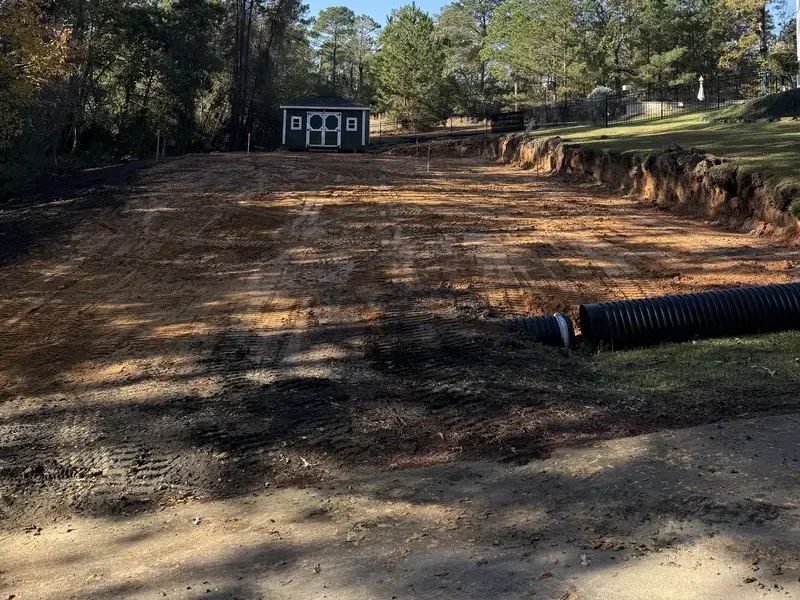
Short answer: site prep is everything that has to happen to a piece of ground before a concrete truck can back onto it. Clearing, access, drainage, and the pad. In that order, because each one depends on the one before it.
And fall is when to do it. The ground around Magnolia is still firm from summer, the afternoons are still warm enough to help material pack, and the lot gets worked before the winter rain turns the low spots into a pond. A lot that goes into December cleared, drained and graded is a lot you can pour on in January. One that goes into December as raw ground waits on the weather, then waits on the ground to dry, then waits on the schedule.
What “site prep” covers
People use the phrase loosely, so it’s worth spelling out. On a new homesite the work runs in four stages.
Clearing. Trees, brush and underbrush come out of the building footprint and wherever the driveway, the septic field and the utilities are going. Stumps come out too, the whole root ball, because a stump left under a pad rots and leaves a hole. Debris gets hauled off rather than pushed into a pile at the back fence that will still be there in five years.
Access. A loaded truck has to reach the site, and it has to reach it every trip for the rest of the build. That’s the driveway base and, where the drive crosses a roadside ditch, the culvert. It goes in early because everything after it rides in on it. A lot with no way in is a lot where the fill gets dumped at the road.
Drainage. Where the water goes now, and where it will go once there is a house in the way. Swales get cut, low corners get filled, and the fall of the ground gets set so water moves away from the footprint instead of toward it. This is the stage that gets skipped when someone is in a hurry, and it’s the one that shows up as a wet slab two winters later.
The pad. Topsoil stripped off the footprint down to firm ground, select fill brought in and compacted in lifts, the pad built up to the finished elevation and run out past the slab line on every side. The house pad guide goes through that part in detail, including the five questions to ask before you sign with anyone.
Why the order matters
Clearing before drainage, because you can’t read the fall of a lot through brush. Access before the pad, because the fill comes in by the truckload and a truck stuck in the yard is a lost afternoon. Drainage before the pad, because a pad built on ground that holds water is a pad built on ground that is going to move.
Get one of them out of sequence and the job is still doable. It just costs a second trip, and the second trip is the one nobody budgeted.
The culvert, and who handles it
If your driveway will cross a ditch on a county-maintained road, the culvert isn’t a call we make on our own. Montgomery County’s permitting page answers “Do I need a permit for a culvert?” with one line: contact your Commissioner Precinct. The precinct that maintains the road is the one that tells you the size, the length and how the ends get finished, and they want to see it before you tie into the road.
A culvert that is too small backs water up on the neighbor upstream. One set too high leaves a hump; one set too low silts in the first season. The precinct’s spec exists to prevent all three, so the sensible move is to make that call early, before the material is ordered. We cover it on the walk-through, and the driveway guide covers what goes on top once the crossing is in.
The county permit question
This part is a fact about what the county says, not advice about what you should do. Montgomery County’s permitting FAQ states that a Development Permit is required for all proposed development within the unincorporated areas of the county, and defines development broadly, including grading, clearing and filling. The same page says it is the property owner’s responsibility to review the exemptions and decide whether they apply. It also states that structures in or within 100 feet of a flood zone must be elevated at least two feet above the Base Flood Elevation.
Those three lines decide a lot about a site prep job, especially the last one. A pad that has to sit two feet above BFE is a pad that needs more fill than the lot looks like it needs from the road, and that’s a number you want before the trucks are scheduled, not after. The county’s page is at mctx.org, and the Permit Department is the place to confirm what applies to your parcel.
What to have ready before the walk-through
Know where your property lines are. Have a rough idea of where the house sits, where the septic goes and which side the driveway comes in on, even if the plans are not final. Mark anything buried that you know about, and call 811 before anyone digs. Check that a loaded dump truck can clear your gate and turn around once it is through.
None of that has to be perfect. It just has to be known, because every one of those things changes where the drainage runs and where the pad goes.
When to call us
If you have a lot and a set of plans, or a lot and an idea, fall is the time to get it walked. We do the clearing, the pad, the drainage and the driveway with our own equipment, and the select fill, bank sand and base rock come on our own trucks, so the whole sequence runs on one schedule instead of four. The walk-through is free and the estimate is in writing.
Tell us where the lot is and what you are planning to build, and we will tell you what the ground needs first. Ask for an estimate or call (832) 704-1783.